

Which U.s. President Signed The First Treaty Reducing The Size Of The Nations' Nuclear Arsenal?
| Strategic Arms Reduction Treaty Договор о сокращении стратегических наступательных вооружений | |
|---|---|
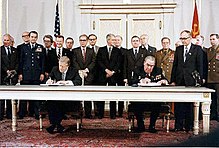
 Presidents George H. West. Bush and Mikhail Gorbachev sign Kickoff, 31 July 1991 | |
| Blazon | Strategic nuclear disarmament |
| Drafted | 29 June 1982 – June 1991 |
| Signed | 31 July 1991 |
| Location | Moscow, Soviet Wedlock |
| Constructive | 5 December 1994 |
| Condition | Ratification of both parties |
| Expiration | 5 December 2009 |
| Signatories |
|
| Parties |
|
| Languages | Russian, English |


Beginning I (Strategic Arms Reduction Treaty) was a bilateral treaty between the The states and the Soviet Spousal relationship on the reduction and the limitation of strategic offensive arms. The treaty was signed on 31 July 1991 and entered into force on five December 1994.[1] The treaty barred its signatories from deploying more than than 6,000 nuclear warheads and a total of ane,600 intercontinental ballistic missiles (ICBMs) and bombers.
START negotiated the largest and most circuitous artillery control treaty in history, and its final implementation in late 2001 resulted in the removal of about 80% of all strategic nuclear weapons then in existence. Proposed by U.s.a. President Ronald Reagan, it was renamed First I afterwards negotiations began on START II.
The treaty expired on 5 December 2009.
On 8 April 2010, the replacement New START Treaty was signed in Prague by U.s. President Barack Obama and Russian President Dmitry Medvedev. Following its ratification past the US Senate and the Federal Assembly of Russia, the treaty went into force on 26 January 2011, extending deep reductions of American and Soviet or Russian strategic nuclear weapons through February 2026.[ii] [three]
Proposal [edit]

Soviet SS-18 intercontinental ballistic missile

The START proposal was beginning appear by US President Ronald Reagan in a commencement address at his alma mater, Eureka Higher, on nine May 1982,[iv] and presented past Reagan in Geneva on 29 June 1982. He proposed a dramatic reduction in strategic forces in 2 phases, which he referred to as SALT Iii.[5]
The kickoff phase would reduce overall warhead counts on any missile type to 5,000, with an boosted limit of 2,500 on ICBMs. Additionally, a total of 850 ICBMs would be allowed, with a limit of 110 "heavy throw" missiles similar the SS-18 and boosted limits on the total "throw weight" of the missiles.
The second stage introduced similar limits on heavy bombers and their warheads, besides as other strategic systems.
The US then had a commanding atomic number 82 in strategic bombers. The aging B-52 force was a credible strategic threat only was equipped with only AGM-86 prowl missiles beginning in 1982 because of Soviet air defense improvements in the early 1980s. The United states had begun to introduce the new B-1B Lancer quasi-stealth bomber as well and was secretly developing the Advanced Applied science Bomber (ATB) project, which would eventually result in the B-two Spirit stealth bomber.
The Soviet strength was of little threat to the US, on the other hand, as it was tasked nearly entirely with attacking US convoys in the Atlantic and land targets on the Eurasian landmass. Although the Soviets had 1,200 medium and heavy bombers, but 150 of them (Tupolev Tu-95s and Myasishchev M-4s) could attain N America (the latter only by in-flight refueling). They likewise faced difficult issues in penetrating US airspace, which was admittedly smaller and less dedicated. Having too few bombers available compared to US bomber numbers was evened out by the US forces being required to penetrate the Soviet airspace, which is much larger and more defended.
That inverse in 1984, when new Tu-95MS and Tu-160 bombers appeared and were equipped with the beginning Soviet AS-15 cruise missiles. Past limiting the phasing in, it was proposed that the United states would exist left with a strategic advantage for a time.
As Time magazine put it, "Under Reagan'south ceilings, the US would take to make considerably less of an adjustment in its strategic forces than would the Soviet Union. That feature of the proposal will near certainly prompt the Soviets to charge that it is unfair and ane-sided. No doubt some American artillery-command advocates will agree, accusing the Administration of making the Kremlin an offering it cannot possibly have—a deceptively equal-looking, deliberately nonnegotiable proposal that is part of what some doubtable is the hardliners' clandestine calendar of sabotaging disarmament so that the Us can get on with the business of rearmament." However, Time pointed out, "The Soviets' monstrous ICBMs accept given them a near iii-to-i advantage over the US in 'throw weight'—the cumulative power to 'throw' megatons of death and devastation at the other nation."
Costs [edit]
Iii institutes ran studies in regards to the estimated costs that the US regime would have to pay to implement Commencement I: the Congressional Upkeep Role (CBO), the US Senate Strange Relations Committee (SFRC), and the Institute for Defense force Analyses (IDA). The CBO estimates causeless that the total-implementation cost would consist of a one-time cost of $410 to i,830 million and that the standing annual costs would be $100 to 390 million.[6]
The SFRC had estimates of $200 to 1,000 million for one-fourth dimension costs and that total inspection costs over the 15-twelvemonth period of the treaty would exist $1,250 to 2,050 million.[7] [ page needed ]
Finally, the IDA estimated only in regards to the verification costs, which it claimed to be effectually $760 million.[viii]
In addition to the costs of implementing the treaty, the Usa likewise aidef to the onetime Soviet republics by the Cooperative Threat Reduction Programme (Nunn-Lugar Program), which added $591 meg to the costs of implementing the First I program in the old Soviet Union, which would almost double the price of the program for the US.[9] [ page needed ]
Afterward the implementation of the treaty, the former Soviet Union'south stock of nuclear weapons would fall from 12,000 to three,500. The US would as well save coin since information technology would not have to be concerned with the upkeep and innovations towards its ain nuclear forces. The CBO estimated that would amount to a total saving of $46 billion in the first v years of the treaty and effectually $130 billion until 2010, which would pay for the cost of the implementation of the treaty about xx times over.[7] [ page needed ]
The other risk associated with Showtime was the failure of compliance on the side of Russia. The The states Senate Defence Committee expressed concerns that Russia could covertly produce missiles, produce false numbers regarding numbers of warheads, and monitoring cruise missiles.
The Joint Chiefs of Staff assessment of those situations determined the risk of a significant violation of the treaty to be inside adequate limits. Another risk would exist the ability for Russia to perform espionage during the inspection of US bases and armed forces facilities. The risk was likewise determined to be an acceptable factor by the assessment.[ix] [ page needed ]
Considering the potential savings from the implementation of START I and its relatively-low risk factor, Reagan and the US government accounted it a reasonable plan of action towards the goal of disarmament.
Negotiations [edit]
Negotiations for Start I began in May 1982, but continued negotiation of the START process was delayed several times considering US understanding terms were considered non-negotiable past pre-Gorbachev Soviet rulers. Reagan's introduction of the Strategic Defense Initiative (SDI) program in 1983 was viewed equally a threat by the Soviets, who withdrew from setting a timetable for further negotiations. In Jan 1985, nevertheless, U.s.a. Secretarial assistant of State George Shultz and Soviet Foreign Government minister Andrei Gromyko discussed a formula for a three-part negotiation strategy that included intermediate-range forces, strategic defense, and missile defense. During the Reykjavík Summit betwixt Reagan and Gorbachev in October 1986, negotiations towards the implementation of the START Program were accelerated and turned towards the reduction of strategic weapons after the Intermediate-Range Nuclear Forces Treaty was signed in December 1987.[x] [ folio needed ]
However, a dramatic nuclear arms race proceeded in the 1980s. It substantially ended in 1991 by nuclear parity preservation with 10,000 strategic warheads on both sides.
Verification tools [edit]
The verification regimes in arms control treaties contain many tools to enable them to hold parties accountable for their deportment and violations of their treaty agreements.[2] The Outset Treaty verification provisions were the most complicated and demanding of whatever agreement at the fourth dimension by providing twelve different types of inspection. Information exchanges and declarations between parties became required and included exact quantities, technical characteristics, locations, movements, and the condition of all offensive nuclear threats. The national technical means of verification (NTM) provision protected satellites and other information-gathering systems controlled by the verifying side, as they helped to verify adherence of international treaties. The international technical ways of verification provision protected the multilateral technical systems specified in other treaties. Co-operative measures were established to facilitate verification past the NTM and included displaying items in obviously sight and non hiding them from detection. The new on-site inspections (OSI) and Perimeter and Portal Continuous Monitoring (PPCM) provisions helped to maintain the treaty'south integrity by providing a regulatory system manned by a representative from the verifying side at all times.[eleven] In add-on, access to telemetry from ballistic missile flight tests are now required, including exchanges of tapes and a ban on encryption and encapsulation from both parties.[12] [ page needed ]
Signing [edit]
Negotiations that led to the signing of the treaty began in May 1982. In November 1983, the Soviet Union "discontinued" communication with the The states, which had deployed intermediate-range missiles in Europe. In January 1985, US Secretary of Country George Shultz and Soviet Foreign Minister Andrey Gromyko negotiated a iii-part plan including strategic weapons, intermediate missiles, and missile defense. It received a lot of attention at the Reykjavik Summit betwixt Ronald Reagan and Mikhail Gorbachev and ultimately led to the signing of the Intermediate-Range Nuclear Forces Treaty in December 1987.[2] Talk of a comprehensive strategic arms reduction continued and the First Treaty was officially signed by US President George H.Westward. Bush and Soviet General Secretarial assistant Gorbachev on 31 July 1991.[thirteen]
Implementation [edit]

There were 375 B-52s were flown to the Aerospace Maintenance and Regeneration Center at Davis-Monthan Air Force Base, in Arizona.[ when? ] The bombers were stripped of all usable parts and chopped into five pieces by a 13,000-pound steel blade dropped from a crane. The guillotine sliced 4 times on each aeroplane, which severed the wings and left the fuselage in 3 pieces. The dissected B-52s remained in identify for three months so that Russian satellites could confirm that the bombers had been destroyed, and they were then sold for scrap.[14]
After the collapse of the Soviet Matrimony, treaty obligations passed to twelve Soviet successor states.[fifteen] Of those, Turkmenistan and Uzbekistan each eliminated its ane nuclear-related sites, and on-site inspections were discontinued. Inspections continued in Belarus, Kazakhstan, the Russian Federation, and Ukraine.[15] Belarus, Kazakhstan, and Ukraine became not-nuclear weapons states under the Treaty on the Not-Proliferation of Nuclear Weapons on ane July 1968 and are committed to it under the Lisbon Protocol (Protocol to the Treaty Betwixt the U.s.a. of America and the Union of Soviet Socialist Republics on the Reduction and Limitation of Strategic Offensive Arms) after they had become contained nations in the wake of the end of the Soviet Wedlock.[16] [17]
Efficacy [edit]
Belarus, Kazakhstan, and Ukraine accept disposed of all their nuclear weapons or transferred them to Russia. The US and Russia have reduced the capacity of delivery vehicles to one,600 each, with no more than than six,000 warheads.[18]
A written report past the US State Section, "Adherence to and Compliance With Arms Control, Nonproliferation and Disarmament Agreements and Commitments," was released on 28 July 2010 and stated that Russia was non in full compliance with the treaty when it expired on five December 2009. The written report did not specifically place Russia'southward compliance problems.[nineteen]
One incident that occurred in regards to Russia violating the Kickoff I Treaty occurred in 1994. It was appear by Arms Command and Disarmament Agency Manager John Holum in a congressional testimony that Russia had converted its SS-19 ICBM into a space-launch vehicle without notifying the advisable parties.[xx] Russia justified the incident claiming that it did not have to follow all of Offset's reporting policies in regards to missiles that had been recreated into space-launch vehicles. In addition to the SS-19, Russian federation was also reportedly using SS-25 missiles to assemble space-launch vehicles. The issue that the US had was that it did non accept accurate numbers and locations of Russian ICBMs with those violations. The dispute was resolved in 1995.[9]
Expiration and renewal [edit]

START I expired on 5 December 2009, but both sides agreed to keep observing the terms of the treaty until a new agreement was reached.[21] There are proposals to renew and expand the treaty, supported past US President Barack Obama. Sergei Rogov, managing director of the Institute of the U.S. and Canada, said: "Obama supports sharp reductions in nuclear arsenals and I believe that Russia and the U.S. may sign in the summertime or fall of 2009 a new treaty that would replace START-one." He added that a new bargain would happen only if Washington abandoned plans to place elements of a missile shield in Fundamental Europe. He expressed willingness "to make new steps in the sphere of disarmament" but said that he was waiting for the U.s.a. to abandon attempts to "surround Russian federation with a missile defense ring" in reference to the placement of ten interceptor missiles in Poland and accompanying radar in the Czechia.
Russian President Dmitri Medvedev, said the mean solar day subsequently the United states elections in his start Country of the Nation accost that Russia would move to deploy short-range Iskander missile systems in the western exclave of Kaliningrad "to neutralize if necessary the anti-ballistic missile system in Europe." Russia insists for whatsoever movement towards New START to be a legally binding document and to set lower ceilings on the number of nuclear warheads and their delivery vehicles.[18]
On 17 March 2009, Medvedev signaled that Russia would begin "large-calibration" rearmament and renewal of Russia's nuclear arsenal. He accused NATO of pushing ahead with expansion near Russian borders and ordered for the rearmament to commence in 2011 with increased army, naval, and nuclear capabilities. Also, the caput of Russian federation's strategic missile forces, Nikolai Solovtsov, told news agencies that Russian federation would start deploying its next-generation RS-24 missiles later on the 5 Dec expiry of the START I. Russia hopes to for a new treaty. The increased tensions came despite the warming of relations betwixt the US and Russia in the two years since Obama had taken role.[22]
On 4 May 2009, the US and Russia began the process of renegotiating START and of counting both nuclear warheads and their delivery vehicles in making a new understanding. While setting aside problematic problems betwixt the two countries, both sides agreed to make further cuts in the number of warheads deployed to around 1,000 to 1,500 each. The Us said that is are open up to a Russian proposal to apply radar in Azerbaijan, rather than Eastern Europe for the proposed missile arrangement. The George Due west. Bush administration insisted that the Eastern Europe defense system was intended as a deterrent for Iran, but Russia feared that information technology could be used against itself. The flexibility past both sides to brand compromises now volition lead to a new phase of artillery reduction in the future.[23]
A "Joint agreement for a follow-on agreement to START-ane" was signed by Obama and Medvedev in Moscow on half-dozen July 2009 to reduce the number of deployed warheads on each side to 1,500–1,675 on 500–1,100 delivery systems. A new treaty was to be signed before START-one expired in December 2009, with reductions to be achieved within seven years.[24] Later on many months of negotiations,[25] [26] Obama and Medvedev signed the successor treaty, Measures to Further Reduction and Limitation of Strategic Offensive Arms, in Prague, Czechia, on 8 Apr 2010.
New Get-go Treaty [edit]
The New START Treaty imposed fifty-fifty more limitations on the United States and Russia by reducing them to significantly-less strategic artillery within seven years of its entering full strength. Organized into three tiers, the new treaty focusses on the treaty itself, a protocol that contains additional rights and obligations regarding the treaty provisions, and technical annexes to the protocol.[27]
The limits were based on stringent analysis conducted by Section of Defence planners in back up of the 2010 Nuclear Posture Review. These aggregate limits consist of 1,550 nuclear warheads which include warheads on deployed intercontinental ballistic missiles (ICBM), warheads on deployed submarine-launched ballistic missiles (SLBM), and fifty-fifty any deployed heavy bomber equipped for nuclear armaments. That is 74% fewer than the limit set in the 1991 Treaty and 30% fewer than the limit of the 2002 Treaty of Moscow. Both parties will also be limited to a combined total of 800 deployed and non-deployed ICBM launchers, SLBM launchers, and heavy bombers equipped for nuclear armaments. There is as well a dissever limit of 700 deployed ICBMs, deployed SLBMs, and deployed heavy bombers equipped for nuclear armaments which is less than half the corresponding strategic nuclear delivery vehicle limit imposed in the previous treaty. Although the new restrictions have been prepare, the new treaty does not contain any limitations regarding the testing, development, or deployment of electric current or planned US missile defense programs and depression-range conventional strike capabilities.[27]
The elapsing of the new treaty is x years and can exist extended for a period of no more than five years at a time. It includes a standard withdrawal clause like most other arms control agreements. The treaty has been superseded by subsequent treaties.[27]
Memorandum of Understanding data [edit]
| Date | Deployed ICBMs and Their Associated Launchers, Deployed SLBMs and Their Associated Launchers, and Deployed Heavy Bombers | Warheads Attributed to Deployed ICBMs, Deployed SLBMs, and Deployed Heavy Bombers | Warheads Attributed to Deployed ICBMs and Deployed SLBMs | Throw-weight of Deployed ICBMs and Deployed SLBMs (Mt) |
|---|---|---|---|---|
| 1 July 2009[28] | 809 | three,897 | 3,289 | ii,297.0 |
| 1 January 2009[29] | 814 | 3,909 | 3,239 | 2,301.8 |
| 1 January 2008[30] | 952 | iv,147 | 3,515 | 2,373.5 |
| 1 September 1990 (USSR)[31] | 2,500 | 10,271 | 9,416 | 6,626.three |
| Date | Deployed ICBMs and Their Associated Launchers, Deployed SLBMs and Their Associated Launchers, and Deployed Heavy Bombers | Warheads Attributed to Deployed ICBMs, Deployed SLBMs, and Deployed Heavy Bombers | Warheads Attributed to Deployed ICBMs and Deployed SLBMs | Throw-weight of Deployed ICBMs and Deployed SLBMs (Mt) |
|---|---|---|---|---|
| one July 2009[28] | one,188 | 4268 | 3456 | one,857.3 |
| ane January 2009[29] | ane,198 | 3989 | 3272 | 1,717.3 |
| 1 January 2008[30] | 1,225 | 4468 | 3628 | ane,826.one |
| 1 September 1990[31] | 2,246 | 10,563 | 8,200 | 2,361.three |
See besides [edit]
- Strategic Arms Limitation Talks
- START 2
- START III
- RS-24
- New START
References and notes [edit]
- ^ [ dead link ] "Strategic Arms Reduction Treaty (START I): Executive Summary". The Office of Treaty Compliance. Archived from the original on 6 January 2011. Retrieved 5 December 2009.
- ^ a b c "Treaty between the United States of America and the Union of Soviet Socialist Republics on Strategic Offensive Reductions (START I) | Treaties & Regimes | NTI".
- ^ "New Showtime Treaty". The states Section of Country. Retrieved 17 August 2021.
- ^ Eureka College Outset Oral communication, 1982
- ^ Time to Showtime, Says Reagan
- ^ U.Due south. Costs of Verification and Compliance Under Awaiting Arms Treaties, U.South. Congress, Congressional Budget Office, September 1990.
- ^ a b The START Treaty, Senate Foreign Relations Committee, 18 September 1992.
- ^ Arms Control Reporter, 1994, pp. 701.D.5-15.
- ^ a b c Allan South. Krass, The United states of america and Arms Control: The Challenge of Leadership, Praeger Publishers, Westport, CT 1997
- ^ KM Kartchner, Negotiating START: Strategic Arms Reduction Talks and the Quest for Strategic Stability
- ^ Woolf, Amy F. "Monitoring and Verification in Arms Control." Congressional Research Service, 23 Dec. 2011, fas.org/sgp/crs/nuke/R41201.pdf.
- ^ Ifft, Edward (2014). Verifying the INF and Showtime Treaties. American Found of Physics Publishing.
- ^ Freedman, Lawrence D. "Strategic Arms Reduction Talks". Britannica, world wide web.britannica.com/upshot/Strategic-Arms-Reduction-Talks#ref261940.
- ^ CNN. Special: Cold State of war. "Uncle Sam'south salve yard: A Cold State of war icon heads for the scrap heap" By Andy Walton, CNN Interactive Archived 23 March 2008 at the Wayback Automobile
- ^ a b Budjeryn, Mariana; Steiner, Steven East. (4 March 2019). "Forgotten Parties to the INF". Wilson Center . Retrieved 28 April 2021.
- ^ Lisbon Protocol, signed by the five START Parties 23 May 1992.
- ^ CIA Fact Book
- ^ a b "Russia, U.S. May sign new First treaty in mid-2009". half-dozen November 2008.
- ^ Gertz, Bill, "Russia Violated '91 START Till Stop, U.S. Report Finds", Washington Times, 28 July 2010, p. 1.
- ^ A Revitalized ACDA in the Postal service-Cold State of war Earth, Firm Commission on Foreign Diplomacy, 23 June 1994
- ^ "US rejects Russian missile shield concerns". BBC News. 29 Dec 2009.
- ^ https://news.yahoo.com/s/afp/20090317/ts_afp/russianatomilitarynuclear [ dead link ]
- ^ Barry, Ellen (5 May 2009). "U.South. Negotiator Signals Flexibility Toward Moscow Over New Circular of Artillery Talks". The New York Times . Retrieved one April 2010.
- ^ U.s.a. and Russia hold nuclear cuts, accessed 16 July 2009
- ^ Baker, Peter; Barry, Ellen (24 March 2010). "Russia and U.Southward. Written report Quantum on Artillery". The New York Times . Retrieved 1 April 2010.
- ^ Early March 2010 Ukrainian President Viktor Yanukovych had proposed to both Russia and the The states to sign the treaty in Kyiv, the majuscule of Ukraine Ukraine awaiting reply to offering of Kyiv as venue for Russia-U.Southward. artillery cuts deal signing, Kyiv Mail (xvi March 2010)
- ^ a b c Columbia International Diplomacy Online, 2010, http://www.ciaonet.org/tape/18773?search=ane
- ^ a b START data for 1 July 2009 on land.gov
- ^ a b Starting time data for 1 January 2009 on country.gov
- ^ a b Outset data for 1 January 2008 on cdi.org Archived 3 May 2012 at the Wayback Machine
- ^ a b START data for i September 1990 on fas.org
Further reading [edit]
- Polen, Stuart. "START I: A Retrospective." Illini Journal of International Security iii.ane (2017): 21-36 online.
- Tachibana, Seiitsu. "Bush-league Assistants'due south Nuclear Weapons Policy: New Obstacles to Nuclear Disarmament." Hiroshima Peace Scientific discipline 24 (2002): 105-133. online
- Woolf, Amy F. Nuclear Artillery Control: The Strategic Offensive Reductions Treaty (DIANE Publishing, 2010). online
External links [edit]
- START1 treaty text, from US State Section
- Engineer Memoirs - Lieutenant General Edward L. Rowny, ambassador for the Strategic Artillery Limitation Talks (Starting time)
- Atomwaffen A-Z Glossareintrag zu Commencement-I-Vertrag

Which U.s. President Signed The First Treaty Reducing The Size Of The Nations' Nuclear Arsenal?,
Source: https://en.wikipedia.org/wiki/START_I
Posted by: stephenspably1960.blogspot.com
0 Response to "Which U.s. President Signed The First Treaty Reducing The Size Of The Nations' Nuclear Arsenal?"
Post a Comment