

Does The Unitedstates Pay Money To Immigrants

Benefits of Immigration Outweigh the Costs
Contributions immigrants brand are an economical boost we cannot overlook.
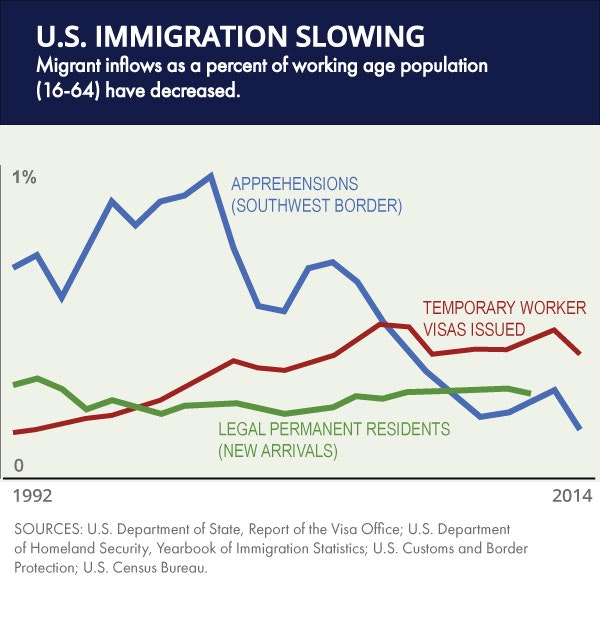
Clearing has emerged as a elevation effect in the presidential campaign. The timing is odd since immigration into the United States has slowed sharply.
Issuance of greenish cards, or permanent resident visas, to new arrivals has been largely flat since 2008, but dipped in 2013 to a vi-year depression. Illegal immigration is near record lows, with migrant apprehensions along the Southwest edge at levels last seen in the 1970s. Temporary work-based visas accept risen slightly in contempo years simply remain below their 2007 peak. Plotting visas and migrant apprehensions as a share of the nation's working-age population, reinforces the point that clearing is slowing in both absolute and relative terms.
More on Immigration from the Bush Institute
A NATION Congenital BY IMMIGRANTS
America is strengthened past the contributions from immigrants. Read stories from American immigrants, deflate clearing myths, and read the Bush Institute policy recommendations.
Economic GROWTH INITIATIVE: Immigration
Pro-growth immigration reform tin raise the pace of economic growth. Learn more most the Bush-league Establish'due south work in immigration.
A lack of legislative action on immigration reform, rise border and interior enforcement of immigration laws, and the slow-growing U.Due south. economy have combined to stem the inflow of immigrant workers. The Mexican case is particularly hit, with demographers suggesting net inflows from Mexico were negative over the five-year menstruum following the Swell Recession. Economic stability in United mexican states, and slower population growth, has dulled the "push factors" that generated mass emigration for four decades.
Against this properties of slowing immigration, it'south surprising that presidential politics are heating up around this issue.
Why we need clearing
Immigration fuels the economic system. When immigrants enter the labor force, they increase the productive capacity of the economy and raise Gross domestic product. Their incomes rise, simply so do those of natives. Information technology'due south a phenomenon dubbed the "immigration surplus," and while a small-scale share of additional Gdp accrues to natives — typically 0.2 to 0.iv percent — it however amounts to $36 to $72 billion per year.
In addition to the immigration surplus, immigrants grease the wheels of the labor market by flowing into industries and areas where there is a relative need for workers — where bottlenecks or shortages might otherwise damp growth.
When immigrants enter the labor forcefulness, they increase the productive chapters of the economy and raise GDP. Their incomes rise, but so do those of natives. It'due south a phenomenon dubbed the "clearing surplus."
Immigrants are more likely to move than natives, and by relieving these bottlenecks to expansion, immigrants increment the speed limit of the economic system. Growth accelerates equally slack falls, a desirable scenario that follows from the improved allocation of resources in the economy.
In that location are many examples — nationally and regionally — of immigrants moving to where the jobs are. During and after World State of war II, Mexican immigrants were instrumental in alleviating shortages arising from the state of war effort. During the oil smash of the late 1970s and early 1980s, there was record migration to Texas. In the 1990s, it was the fast-growing South and Mountain West states that received immigrants, many for the get-go time.
In terms of occupations, immigrants flowed into high-tech jobs during the Internet boom and construction jobs during the 2000s housing boom.
Immigrants grease the wheels of the labor market by flowing into industries and areas where there is a relative need for workers — where bottlenecks or shortages might otherwise damp growth.
In addition, the rise in loftier-skilled immigration, a pronounced tendency since the 1990s, has been linked to innovation, specifically to college patenting rates among immigrants. Interestingly, greater innovation among immigrants appears to boost it amidst natives, as well. Immigrants innovate more than natives because they are concentrated in STEM occupations where there is lots of R&D and entrepreneurial activity
Xl-4 percent of medical scientists are foreign built-in, for example, as are 42 percent of estimator software developers. Immigrant workers are too overrepresented among college professors, engineers, mathematicians, nurses, doctors and dentists, to name a few.
If immigration makes the economy larger, more than efficient and productive, what'south the problem? Why practice nosotros, as a nation, strictly limit clearing?
 The Bush-league Insttitue hosted a naturalization ceremony honoring twenty new citizens from 12 countries, July 10, 2013. (Grant Miller / George Westward. Bush Presidential Center)
Yes, at that place are downsides
Immigration changes factor prices — it lowers the wages of competing workers, while raising the return to upper-case letter and the wages of complementary workers. In other words, the clearing surplus does not accrue equally to everyone. Information technology goes primarily to the owners of capital, which includes business organization and land-owners and investors.
Complementary workers also benefit. The demand for these workers rises with more immigration. They may exist construction supervisors, translators, pharmaceutical reps, or immigration lawyers. And consumers benefit from the lower prices of the goods and services that immigrants produce. Simply competing workers' wages autumn, at least in the initial transition period every bit the economy adjusts to the new labor inflow.
Research suggests that previous immigrants suffer more than of the adverse wage furnishings than do natives. Prior immigrants are more like current immigrants.
Enquiry besides suggests whatever negative wage effects are full-bodied among low-skilled and not high-skilled workers. Perhaps that is because high-skilled U.South.-born workers are complementary to immigrants to a greater extent than native depression-skilled workers, who hold jobs that crave less education and fewer linguistic communication skills.
Overall, we are talking well-nigh a plus
Immigration is thus a positive simply also disruptive alter. At that place are lots of historical examples of positive nevertheless disruptive economic change. The Industrial Revolution displaced millions of farm workers and resulted in the neat urban migrations and the nascency of mega-cities to which we now ascribe all kinds of positive attributes, including creativity and innovation and college wages.
No great change is without some brusque-term toll. What is costly in the long-term is preventing market forces from funneling resource to their all-time use. The adjustment of wages and prices to the changing demand and supply in the economy are the levers of capitalism that straight resources to their best allocation.
Immigration has internet benefits. The fact that information technology has some costs is non a reason to bar information technology, simply rather to manage it. Mechanisms can be found to benefit from immigration's gains while making up for the losses of some workers. International merchandise has similar effects, and workers adversely affected by trade are eligible for federal programs such as Trade Adjustment Assistance.
Immigration has net benefits. The fact that it has some costs is not a reason to bar it, just rather to manage information technology.
International migration is non much dissimilar than domestic migration, at to the lowest degree non in terms of economic science. We Texans often celebrate Californians and others who motility to Texas for the abundant jobs, lower house prices and bottom revenue enhancement burden. In Texas, nosotros have depended on this arrival of labor from other states to grow every bit fast as we have — about twice as fast as the nation since 1990. The country has benefited from the migration as have those who moved hither.
Would wages have been higher without the inflow of labor? Perhaps temporarily. But wage inflation and skill shortages would have choked off investment and firms would have expanded elsewhere, in places where they could readily find more competitively priced resources.
Immigration is a net positive, even for those who don't motion, simply the gains are not distributed equally. The adjacent step for policymakers is to structure immigration reform to take advantage of immigration's many benefits while mitigating the costs.
Clearing is a net positive, even for those who don't move, but the gains are not distributed equally. The next step for policymakers is to construction immigration reform to take advantage of immigration'south many benefits while mitigating the costs.
Get out your feedback with The Catalyst editors

Pia Orrenius Vice President and Senior Economist at the Dallas Federal Reserve Banking concern and Fellow at the John Tower Eye for Political Studies at Southern Methodist University, Orrenius also is a member of the Bush Institute's Economical Growth Initiative'southward Advisory Coun Read bio
Source: https://www.bushcenter.org/catalyst/north-american-century/benefits-of-immigration-outweigh-costs.html
Posted by: stephenspably1960.blogspot.com
0 Response to "Does The Unitedstates Pay Money To Immigrants"
Post a Comment